The project was done for an annual 3 day SACES workshop organised by the Society of Architecture and Civil Engineering Students at the University of Malta. Building something out of waste material was the most instinctive thing to do.
Which we did, but we also wanted to encapsulate an other intangible waste; The waste of ideas from self-inhibition (shame, shyness, distrust)
Used plastic bottles were utilized as a way to contain and store ideas written down on paper; using the concept of the message in a bottle.
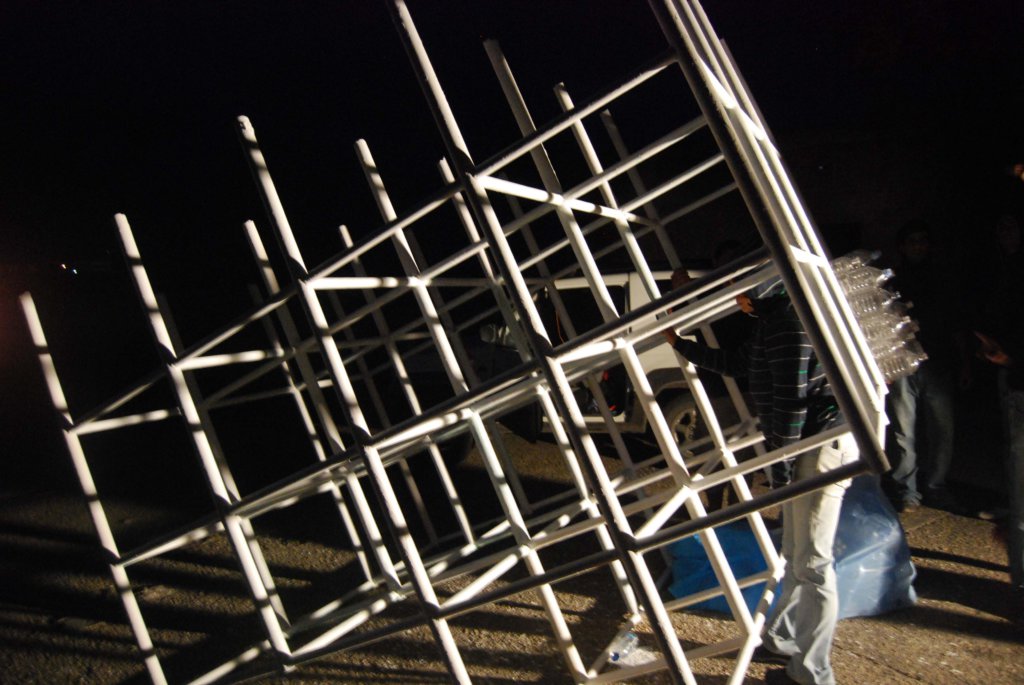
On the site of the workshop we found a discarded steel frame previously used as “Monkey bars” in an abandoned playground.
We found this steelframe to be ideal to hold these thoughts and ideas together as one monumental body. Furthermore these ‘monkey bars’ reminds in the act of play, an action were self-inhibition is pushed aside for creativity and individualism to get loose.
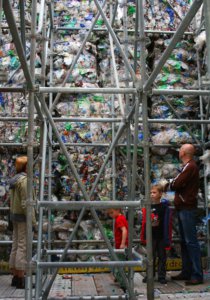
The project was used as an interactive sculpture where visitors would go around/below/inside the steel frame, choose their desired bottle and white down whatever thought they feel like to go out in the open. Approximately 480 bottles were used. The translucency of the material made it possible to be used at night as a lantern, attracting more visitors during the night.
Jasmine Zimmerman created an open-roofed spherical house which measures 12 x 12 x 6 feet (3.6 x 3.6 x 1.8 meter) created out of thousands of PET bottles. With this structure she wanted to point out the fact that Americans waste over 30 billion of PET bottles a year, only 10% of which are recycled.
The structure is created by glueing PET bottles together with hot glue pistol (which by the way renders the bottles unrecyclable in any normal fashion). As an object for raising awareness it can be considered successful however, because she made two installations at festivals (Bumbershoot and City Sol Festival in New York) where people themselves actually added their disposable PET bottles to the structure. In that way the structure grew in an almost organic fashion and people were more directly confronted with the waste issue.
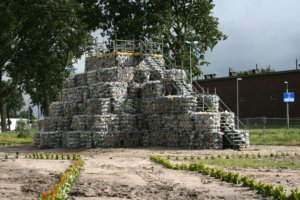
The Trash temple is constructed out of a number of blocks which are actually pressed bales of millions of PET bottles. The temple was designed by Salzig Design. The structure won second prize at the International Ideas Competition at Folly Dock 2007.
The temple was seven meters high, 10 meters wide, and has a circumference of about 25 meters. Visitors could climb up to the top and also enter the structure on ground level. The idea was that in this place where they could perceive the smell of the garbage they would understand the uselessness of overproduction. The structure was surrounded by thousands of sunflowers that marked the footpaths and added symmetry to the place of contemplation.
TrussFab isan integrated end-to-end system that allows users to fabricate large scale structures that are sturdy enough to carry human weight. TrussFab achieves the large scale by complementing 3D print with plastic bottles.
Unlike previous systems that stacked bottles as if they were “bricks”, TrussFab considers them as beams and uses them to form structurally sound node link structures based on closed triangles, also known as trusses. TrussFab embodies the required engineering knowledge, allowing non-engineers to design such structures.
While freestanding bottles tend to break easily, truss structures essentially consist of triangles. In such an arrangement, it is the structure that prevents de-formation, not the individual bottle. The main strength of trusses is that they turn lateral forces (aka bending moments) into tension and compression forces along the length of the edges (aka members). Bottles make great members: while they buckle easily when pushed from the side, they are very strong when pushed or pulled along their main axis. TrussFab affords building trusses by combining tetrahedra and octahedra into so-called tetrahedral honeycomb structures.
Conclusion:
TrussFab is an integrated end-to-end system that allows users to fabricate large structures that are sturdy enough to carry human weight on desktop 3D printers. Unlike previous systems that built on up-cycled plastic bottles combined with 3D print, TrussFab considers bottles not as “bricks”, but as beams that form structurally sound node link structures also known as trusses, allowing users to handle the forces resulting from scale and load. TrussFab embodies the required engineering knowledge, allowing non-engineers to design such structures and allows users to validate their designs using integrated structural analysis.
Veronika Richterová is a Czech PET bottle artist having generated thousands of art objects from this material. Additionally, she has collected PET bottles from all over the world to showcase them in a museum of PET bottles.
The artist is presenting a possible use of PET bottles in theatre architecture or public installations. For transforming the material she employs hot air gun and regular carpentry tools. Attachment points are purely mechanical and the sculptures can be recycled after demounting.
Three giant fish made out of PET bottles was an installation that was part of a United Nations Conference on Sustainable Development. The three fish were created under the slogan »recycle your attitude« and should resemble a family. The sculptures can be lit at night in various colors.
Legge Lewis Legge Cup City was a temporary interactive art installation comprised of a 2000- square-foot structure built using rented chain link fence panels at the Austin City Limits Music Festival, September 23–25, 2005, in Austin, Texas. Over the course of three days, concertgoers filled the structure with approximately 25,000 recycled cups and bottles. Budget $5000 Commissioned by and presented in collaboration with Austin Green Art. The walls of the lounge were slowly filled with disposable containers by concert-goers and volunteers, many of whom spent hours arranging and rearranging patterns in the chain link panel walls. Cup City engaged and displayed a portion of the Festival crowds’ stream of consumption, diverting approximately 25,000 used bottles, cups and cans into its ever-changing web.
Cup City inside, photo: Andrea LeggeeggeCup City construction, photo: Andrea LeggeeggeCup City inside, photo: Andrea Leggeegge
Aurora Robson is a Canadian artist who has been working with garbage for over 10 years. During this time around 80 000 PET bottles went through her hands and easily 100 000 caps. In The Great Indoors instalation she had collected 15 000 PET bottles to assemble an exotic looking tunnel in a gallery. Not only she had collected the bottles on her own, but she also engages homeless and poor people in the collecting of bottles.
Currently, she is not only organising a collective of artists working with plastic debris called Project Vortex but she is also teaching a course on how to work with garbage.
Aurora Robson The Great Indoors 18 September – 26 October 2008
ECO Project with students of the Experimental studio Achten/Nováková at FA CTU Prague2014. Relax square was showing one minute production of PET bottles. It took only few hours to assemble.


 TrussFab is an integrated end-to-end system that allows users to fabricate large scale structures that are sturdy enough to carry human weight. TrussFab achieves the large scale by complementing 3D print with plastic bottles.


