This ECO activist and former East German prisoner founded the Pura Vida organization in order to help people in solving the garbage problem in the village of San Marcos. Two years later it moved to Lake Atitlan to form an Ecological movement: Susana Heisse invented the technology of ECO-brick: a PET bottle stuffed with oter plastic garbage. The ECO-brick is light, insulating and sustainable building unit using only local resources. When cleaned and closed its hygienic and shows safer behaviour during earthquakes.
After a hurricane Stan in 2005 Susana Heisse realized garbage could be turned into cheap building material. In 2008 Pura Vida developed their first Alternative Recycle Manual (www.puravidaatitlan.org), where communities around the world can learn how to transform garbage into construction.
This house was built from empty plastic bottles by Maria Ponce, 76, who lives in the village of El Borbollon, El Salvador. Maria built this house in 2003 with plastic bottles because she did not have enough money to make it in the usual way. Below, Maria stands inside of her home, showing off the roof, which is also built from plastic bottles.
…
Maria in front of her house
Maria inside of her house
the decorated floor
Eighty-six-year-old Maria Ponce, stands at the door of her house in the village of El Borbollon, El Transito, west of San Salvador, on March 14, 2017.
Campo Cielo is a sort of club room for women realized in Tegucigalpa, Honduras, 2004 by Andreas Froese. It offers shelter for about eight people. The building has an integrated water tank which required that cement had to be used in order to protect the earth mortar from water.
Froese usually does not apply cement in the walls of the buildings, but rather relies on earth mortar to stick the PET bottles together (see for example also the Trivadrum Cerala in India on this page).
In order to experiment with vault structures incorporating PET bottles, the study object Aquaducto Romano was built by the Foundation Ecopark Zamorano in Honduras. A copy of a Roman aquaduct, multiple methods of building and more than ten different mixtures of mortar (mixtures of cement, earth, and lime) are tested in this object.
Froeses’ work has found a lot of application all over the world, and can be found from Honduras and Mexico to Nigeria, India, and other countries.
In order to experiment with vault structures incorporating PET bottles, the study object Aquaducto Romano was built by the Foundation Ecopark Zamorano in Honduras. A copy of a Roman aquaduct, multiple methods of building and more than ten different mixtures of mortar (mixtures of cement, earth, and lime) are tested in this object.
Froeses’ work has found a lot of application all over the world, and can be found from Honduras and Mexico to Nigeria, India, and other countries.
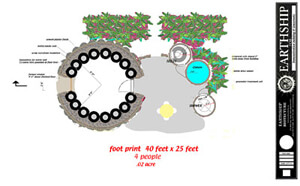
After we finish up our prototype demonstration Earthship at the Grassroots compound in late January, 2011, we are taking what we learned from that and what we have absorbed from our time spent with the Haitian people and attempting to move forward with project H.E.L.P. – Haiti Eco Living Project. Groups of Earthships the Haitian people can build themselves that are absolutely sustainable. These Earthships are built using materials found in and around Port-Au-Prince.